Set up: flat, closed and smooth
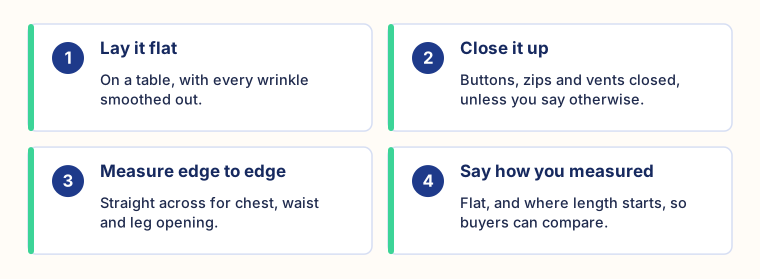
Apparel makers measure finished garments flat on a table, wrinkles smoothed, with fasteners and vents closed.[1] A flat measurement is across one side of the garment, not around the body.
Tops, shirts and jackets
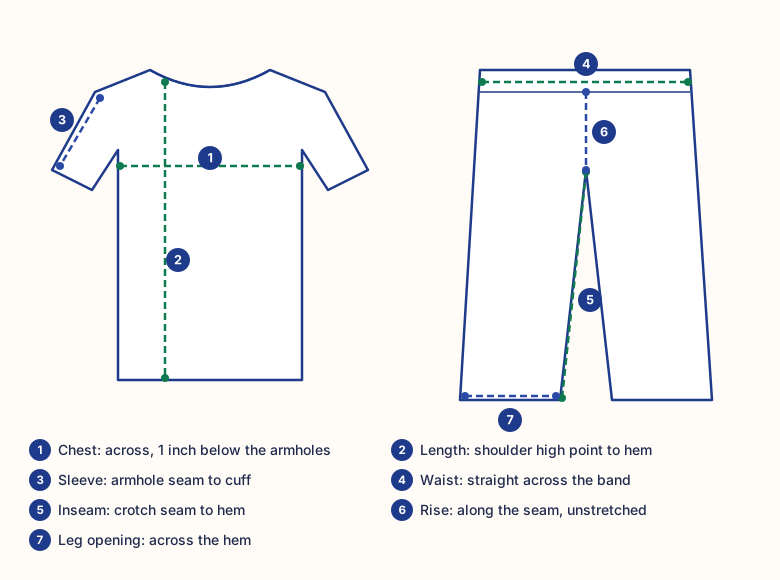
- Chest: straight across, 1 inch below the armhole, edge to edge.[1] A wholesaler's chart measures the same width, 1 inch under the armhole.[2]
- Length: from the high point of the shoulder on the front, down to the bottom edge.[1] Some charts use centre back, from the neck seam to the hem, so say which you used.[2]
- Sleeve: from the top of the armhole seam along the outside fold to the end of the cuff.[1]
Sellers on eBay's forum say armpit to armpit and length are the two numbers they give first.[3]
Pants, jeans and skirts
- Waist: lay the band smooth with front and back edges aligned, then measure straight across, outer edge to outer edge.[1]
- Inseam: from the crotch seam to the bottom of the leg, following the seam.[1]
- Rise: along the front or back rise seam, as straight as possible without stretching.[1]
- Leg opening: straight across the bottom opening, edge to edge.[1]
For pants, eBay suggests the supported waist size plus the inseam; for dresses, bust, waist and length when fit may vary.[4]
Putting it in the listing
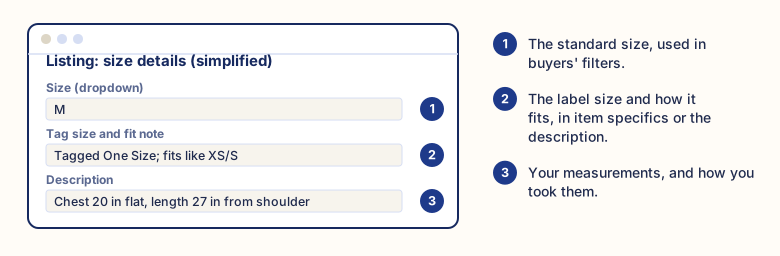
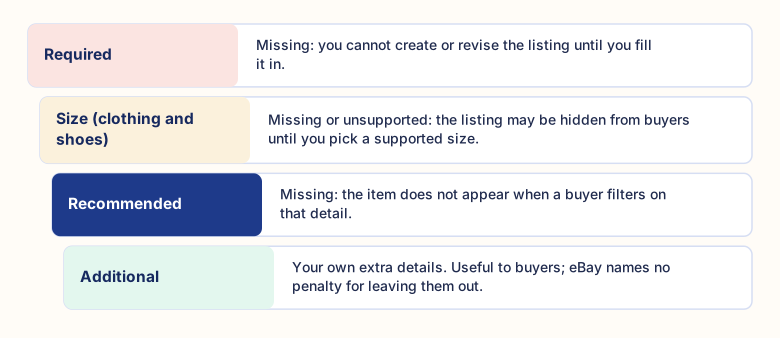
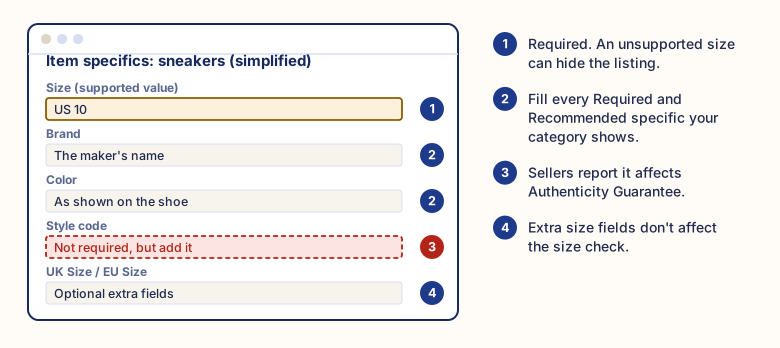
Note if the item runs large, is slim or oversized.[4] The standard size is what buyers filter on; see missing item specifics for what happens when it is wrong.[4]
Do measurements prevent returns?
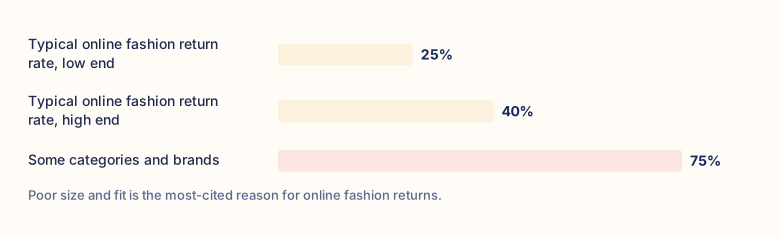
In tests at a large fashion retailer, size advice cut size-related returns by 4.3% for one product group, and had no significant effect for another.[8] A 2025 study at a high-end retailer found shoppers who used a size finder were 0.65% more likely to return an item.[9]
Those studies tested retailer size tools, not a reseller's tape measure. Sellers on eBay's forum report fewer returns when they list measurements, while one notes that measurements do not equal fit.[3]
Measuring checklist
Questions sellers also ask
What is pit to pit?
Should I double the flat chest measurement?
We found no rule for resellers, from eBay or anyone else. Whatever you give, say that it is measured flat, so buyers can compare it with a shirt of their own laid flat.[1]
Does eBay have a measurements field?
eBay's sizing guide asks for measurements such as waist, inseam, chest or length, and for tag size and fit notes in item specifics or the description.[4]
References
- Orvis (apparel brand; supplier measurement manual). (n.d.). Methods of Measuring. Industry guide
https://cdn.orvis.com/files/OrvisMethodsOfMeasuringNov10.pdf (accessed 22 November 2026) - SanMar (apparel wholesaler). (n.d.). Measuring Chart. Industry guide
https://SanMar.com/medias/sys_master/root/h28/ha9/8850524831774/measuringChart.pdf (accessed 22 November 2026) - eBay Community (Selling board). (n.d.). Sellers Who Don't Give Measurements. Seller forum (anecdotal)
https://community.ebay.com/t5/Selling/Sellers-Who-Don-t-Gve-Measurements/m-p/34756045/highlight/true (accessed 22 November 2026) - eBay. (2026, August 28). How to list sizes on eBay. Official help
https://pages.ebay.com/listing-sizes (accessed 22 November 2026) - International Organization for Standardization (ISO). (2017, March 0). ISO 8559-1:2017 Size designation of clothes — Part 1: Anthropometric definitions for body measurement. Standard
https://www.iso.org/standard/61686.html (accessed 22 November 2026) - ASTM International. (2025, September 11). Standard Terminology Relating to Body Dimensions for Apparel Sizing (ASTM D5219-25). Standard
https://store.astm.org/d5219-25.html (accessed 22 November 2026) - Ernestine Porter; University of Idaho Cooperative Extension Service. (1987, June 0). Menswear (Bulletin No. 66). Academic
https://objects.lib.uidaho.edu/uiext/uiext23021.pdf (accessed 22 November 2026) - Andrea Nestler, Nour Karessli, Karl Hajjar, Rodrigo Weffer, Reza Shirvany; ACM (KDD '21, 27th ACM SIGKDD Conference on Knowledge Discovery and Data Mining); preprint arXiv:2106.03532. (2021). SizeFlags: Reducing Size and Fit Related Returns in Fashion E-Commerce. Academic
https://arxiv.org/pdf/2106.03532 (accessed 22 November 2026) - Pankaj C. Patel, Stefan Karlsson, Pejvak Oghazi; Journal of Innovation & Knowledge (Elsevier), 10(5), 100779. DOI: 10.1016/j.jik.2025.100779. (2025). Fits like a glove? Knowledge and use of size finders and high-end fashion retail returns. Academic
https://www.elsevier.es/en-revista-journal-innovation-knowledge-376-articulo-fits-like-glove-knowledge-use-S2444569X25001246 (accessed 22 November 2026)
How this page was made: every factual sentence carries a numbered reference to a source we read on the date shown. Platform rules change, so check the official page before you act on a deadline or a fee. Forum threads are marked anecdotal and are used only to show what sellers report. See how we research.