The limits and the rules
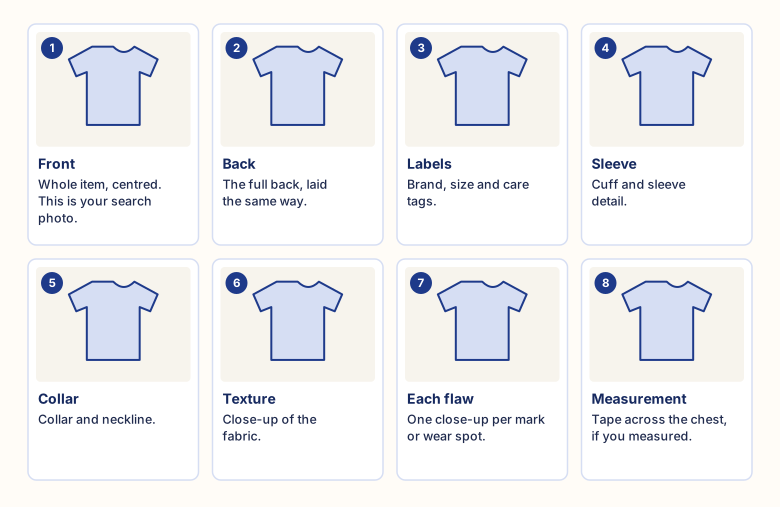
Which shots for clothes
eBay's clothing guide asks you to think about what a shopper would examine in a store, and to photograph that.[4] Use a light background for dark clothes and a dark one for light clothes, in natural light where possible.[4]
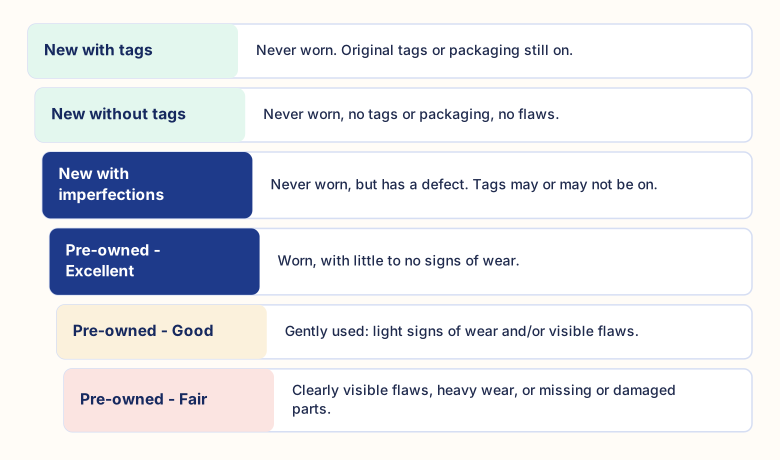
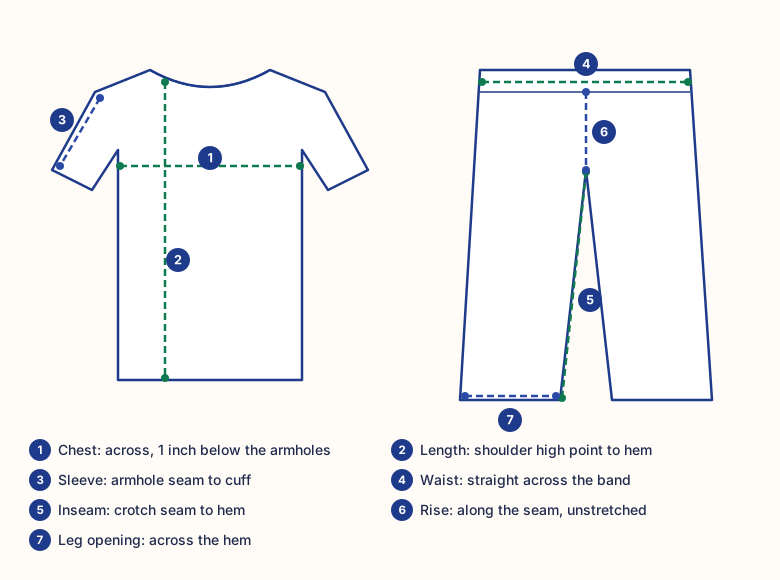
Flaw photos back up the grade you choose; see which condition to choose. For the tape shot, see how to measure clothing.
Which shots for sneakers
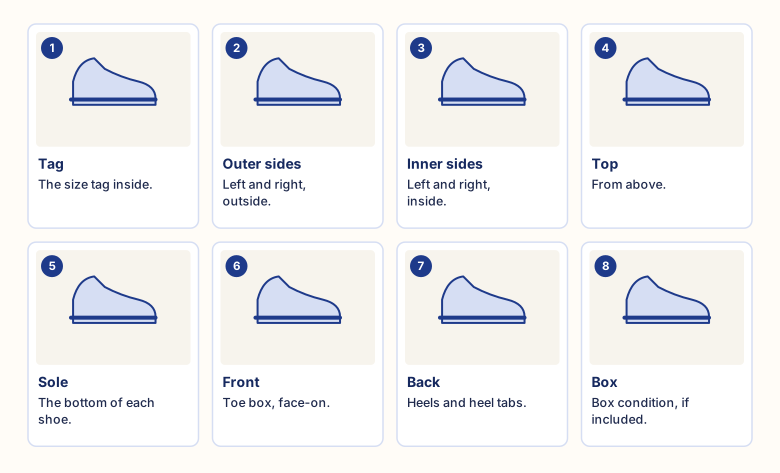
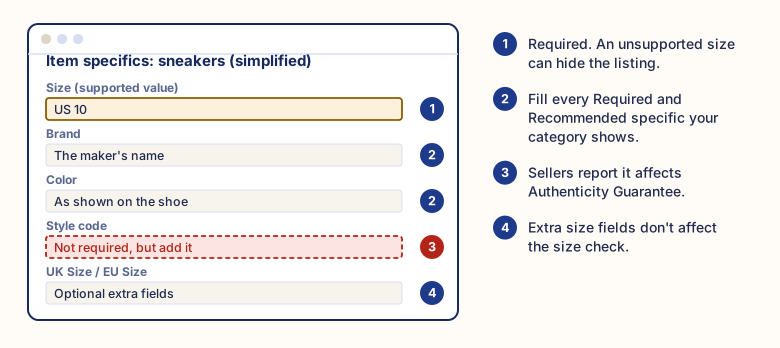
Only show items the buyer will receive, and show all defects.[3] For sneakers checked by eBay's authenticators, the item must be consistent with the title, description and images.[3] More in item specifics for shoes.[3]
Light and background
What research says about photos and sales
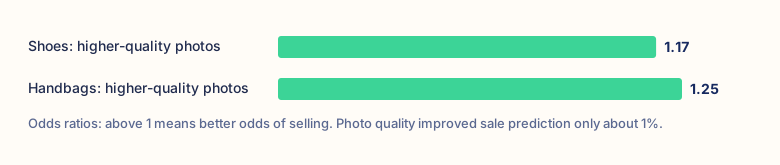
In the same study, high-quality photos taken by sellers outperformed stock imagery on trust.[6] In an online survey of 300 people, a marketplace with better images scored about 3.8 out of five on trust, against 3.7 for stock imagery and 3.4 for low-quality images.[7]
On eBay Motors, going from 9 to 10 photos was associated with a selling price about 1.75% higher, with each extra photo adding less.[8] On Airbnb, properties with professional photos had 8.98% higher occupancy.[9] Neither study covers clothing or shoes.
Photo checklist
Questions sellers also ask
What is the maximum number of photos on eBay?
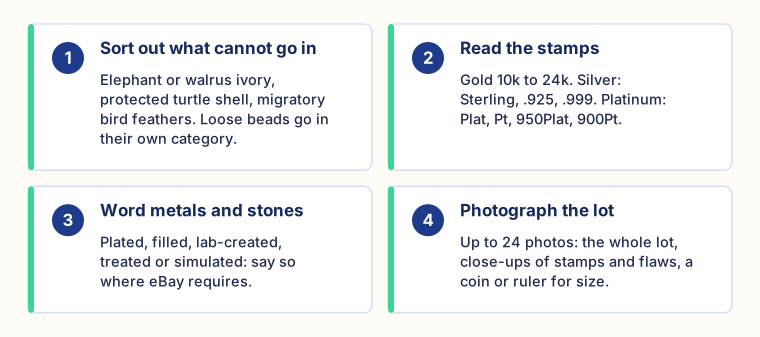
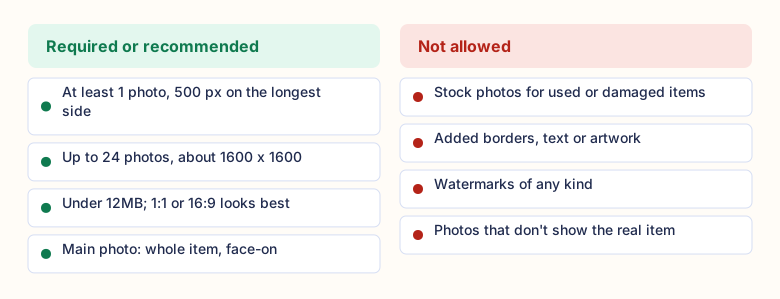
Up to 24 photos per listing.[2]
Can I use a stock photo for a used item?
No. eBay does not allow stock photos for used, damaged or defective items.[1]
References
- eBay. (n.d.). Picture policy. Official policy
https://ebay.com/help/policies/listing-policies/picture-policy?id=4370 (accessed 22 November 2026) - eBay. (n.d.). Adding pictures to your listings. Official help
https://www.ebay.com/help/selling/listings/adding-pictures-listings?id=4148 (accessed 22 November 2026) - eBay Seller Center. (n.d.). Selling sneakers. Official help
https://ebay.com/sellercenter/selling/selling-sneakers (accessed 22 November 2026) - eBay Seller Center. (n.d.). Selling clothes. Official help
https://www.ebay.com/sellercenter/selling/what-to-sell/selling-clothes (accessed 22 November 2026) - eBay Seller Center. (n.d.). Take great photos. Official help
https://www.ebay.com/sellercenter/listings/photo-tips (accessed 22 November 2026) - Xiao Ma, Lina Mezghani, Kimberly Wilber, Hui Hong, Robinson Piramuthu, Mor Naaman, Serge Belongie; arXiv (Cornell University); presented at WACV 2019. (2018, November 26). Understanding Image Quality and Trust in Peer-to-Peer Marketplaces. Academic
https://arxiv.org/abs/1811.10648v1 (accessed 22 November 2026) - Melanie Lefkowitz; Cornell Chronicle (Cornell University). (2019, January 8). Is seeing believing? Depends on photo quality, study says. News
https://www.news.cornell.edu/stories/2019/01/seeing-believing-depends-photo-quality-study-says (accessed 22 November 2026) - Gregory Lewis; American Economic Review (American Economic Association); working-paper copy at Harvard DASH. (2011). Asymmetric Information, Adverse Selection and Online Disclosure: The Case of eBay Motors. Academic
https://dash.harvard.edu/bitstream/handle/1/4724767/lewis_asymmetricinformation.pdf?sequence=2 (accessed 22 November 2026) - Shunyuan Zhang, Dokyun Lee, Param Vir Singh, Kannan Srinivasan; Management Science (INFORMS). (2022). What Makes a Good Image? Airbnb Demand Analytics Leveraging Interpretable Image Features. Academic
https://econpapers.repec.org/RePEc:inm:ormnsc:v:68:y:2022:i:8:p:5644-5666 (accessed 22 November 2026)
How this page was made: every factual sentence carries a numbered reference to a source we read on the date shown. Platform rules change, so check the official page before you act on a deadline or a fee. Forum threads are marked anecdotal and are used only to show what sellers report. See how we research.