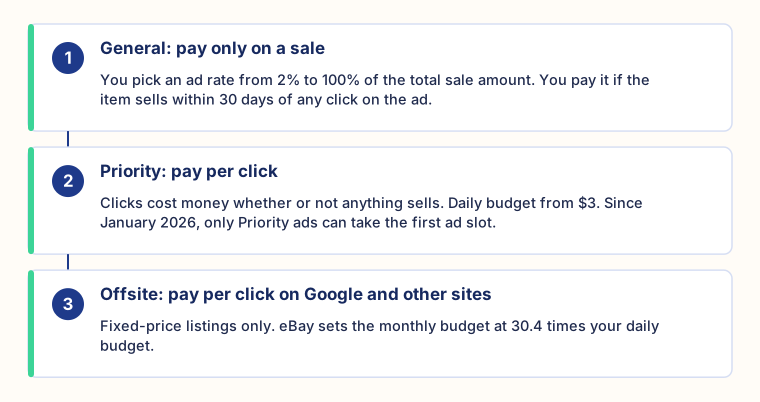
How each campaign charges you
The ad rate is a percentage of the item's total sale amount, including shipping and any taxes or fees.[1] A higher rate raises the chance of an ad placement, not the chance of a sale.[1]
Priority clicks are priced in a second-price auction, and you can cap the cost per click.[2] Above Standard or Top Rated sellers with enough account activity can promote fixed-price listings in most categories.[1]
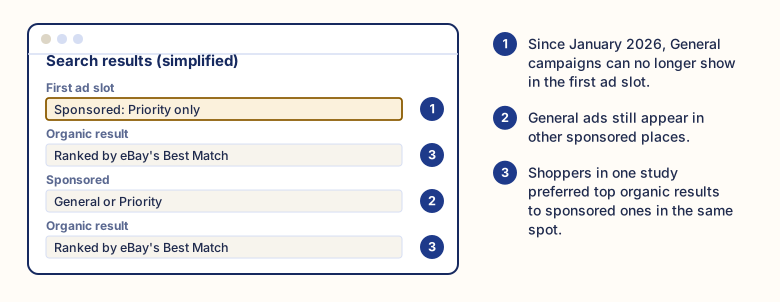
What changed in January 2026
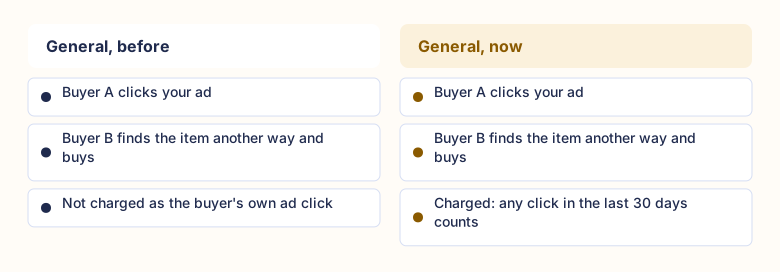
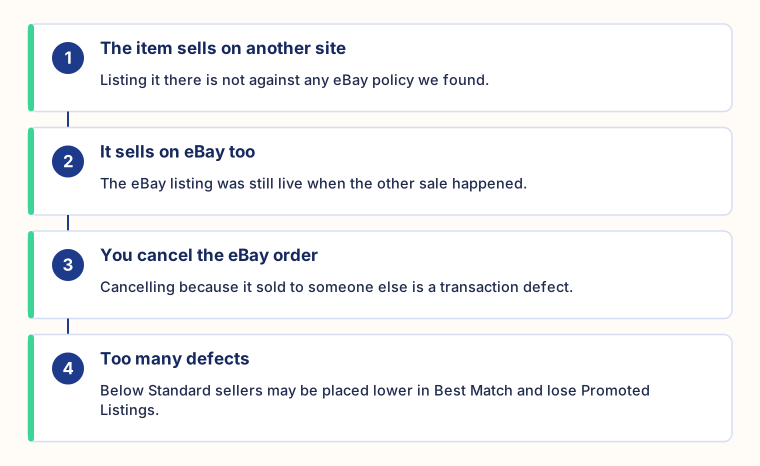
General campaigns no longer use Direct and Halo attribution, and you are charged the rate in effect at the time of sale.[3] Trade news reports that for an item with several in stock, one click can attach the fee to every sale for the next 30 days.[6]
Older guides describe the old rules
Guides written before January 13, 2026 describe buyer-by-buyer attribution for General ads; it now applies on all eBay sites.[3]
What the evidence says
eBay reports that sellers saw over 100% more impressions with General promotion, from January to March 2026.[7] Impressions are views, not sales, and eBay adds that results still depend on demand, price and listing quality.[7]
Economists at eBay ran large field experiments on its own Google search ads. Turning off brand-keyword ads lost almost no traffic: 99.5% of it arrived anyway.[8] Non-brand ads returned an estimated −63%, because most spending went on clicks from people who would buy anyway.[8]
Read this study carefully
It measured eBay buying ads on Google, which is closest to Promoted Offsite, not sellers' Promoted Listings. Its lesson carries over: ads also reached new and infrequent shoppers, who were the ones they helped.[8]
Work out your highest rate
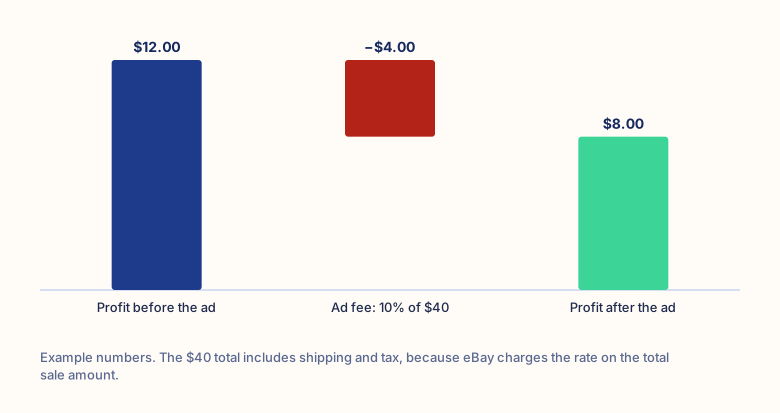
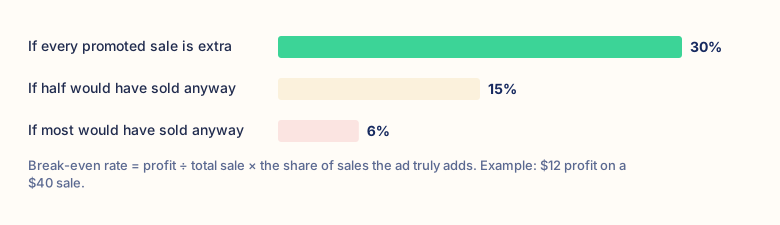
Because the fee is a rate on the total sale amount, the most you can pay and still profit is your profit divided by that total.[1] Then scale it down by how many promoted sales would have happened anyway; that share is the part attribution reports cannot show.[8]
Before you promote an item
- Work out profit ÷ total sale amount, including shipping and tax. Never set the ad rate above it.[1]
- Start lower on items that already sell without ads; most ad-attributed sales may have happened anyway.[8]
- Prefer General for a first test: you pay only when the item sells.[3]
- Use Priority only with a daily budget you can afford to spend on clicks that may not sell.[2]
- If you use a dynamic rate, check what the suggested rate is doing to your margin.[1]
Questions sellers also ask
Do I pay for Promoted Listings if the item does not sell?
Is the ad rate charged on shipping?
Yes. It is a percentage of the total sale amount, including shipping and applicable taxes and fees.[1]
Can a listing be in more than one campaign?
A listing can be in several Priority campaigns at once, but only ever in one General campaign.[10]
References
- eBay. (n.d.). General campaign strategy. Official help
https://www.ebay.com/help/selling/ebay-advertising/promoted-listings/general-campaign-strategy?id=4164 (accessed 22 November 2026) - eBay. (n.d.). Priority campaign strategy. Official help
https://www.ebay.com/help/selling/ebay-advertising/promoted-listings/priority-campaign-strategy?id=5299 (accessed 22 November 2026) - eBay Community (eBay staff announcement). (n.d.). Seller Announcement: Updates to eBay’s Promoted Listings are coming soon. Official blog
https://community.ebay.com/forum/announcements-57928/topic/seller-announcement-updates-to-ebays-promoted-listings-are-coming-soon-8506/ (accessed 22 November 2026) - Mingyu Joo, Jiaqi Shi, Vibhanshu Abhishek; Marketing Science (INFORMS), vol. 43, no. 4, pp. 817-839 (2024). (n.d.). Do Sellers Benefit from Sponsored Product Listings? Evidence from an Online Marketplace. Academic
https://econpapers.repec.org/RePEc:inm:ormksc:v:43:y:2024:i:4:p:817-839 (accessed 22 November 2026) - eBay. (n.d.). How eBay Advertising attribution works. Official help
https://pages.ebay.com/sell/pl/attribution.html (accessed 22 November 2026) - Liz Morton; Value Added Resource. (2026, March 7). Early Fallout From eBay’s Promoted Listings Ad Attribution Changes Raises Questions About Rising Fees. News
https://www.valueaddedresource.net/ebay-promoted-listings-ad-attribution-update-fallout/ (accessed 22 November 2026) - eBay Community (eBay staff announcement). (n.d.). Promote with confidence: A deep dive into suggested ad rate. Official blog
https://community.ebay.com/forum/announcements-57928/topic/promote-with-confidence-a-deep-dive-into-suggested-ad-rate-8968/ (accessed 22 November 2026) - Thomas Blake, Chris Nosko, Steven Tadelis; Econometrica (Econometric Society), vol. 83, pp. 155-174 (2015); working paper: NBER WP 20171 (May 2014). (n.d.). Consumer Heterogeneity and Paid Search Effectiveness: A Large-Scale Field Experiment. Academic
https://www.nber.org/papers/w20171 (accessed 22 November 2026) - eBay. (n.d.). Promoted Offsite. Official help
https://www.ebay.com/help/selling/ebay-advertising/promoted-offsite?id=5471 (accessed 22 November 2026) - eBay. (n.d.). Promoted Listings overview. Official help
https://www.ebay.com/help/selling/ebay-advertising/promoted-listings-overview?id=5295 (accessed 22 November 2026)
How this page was made: every factual sentence carries a numbered reference to a source we read on the date shown. Platform rules change, so check the official page before you act on a deadline or a fee. Forum threads are marked anecdotal and are used only to show what sellers report. See how we research.